
GotoAI supports the development of Japan Self-contained AI, accelerating AI adoption among Japanese companies. The core LLMs sit inside your own organization or within Japan, so your data is never transferred outside your company or outside the country. We provide end-to-end support from assessment through to implementation of AI systems, so to eliminate the risk of information leak from the root.
1. Why Japan Self-contained AI is needed now
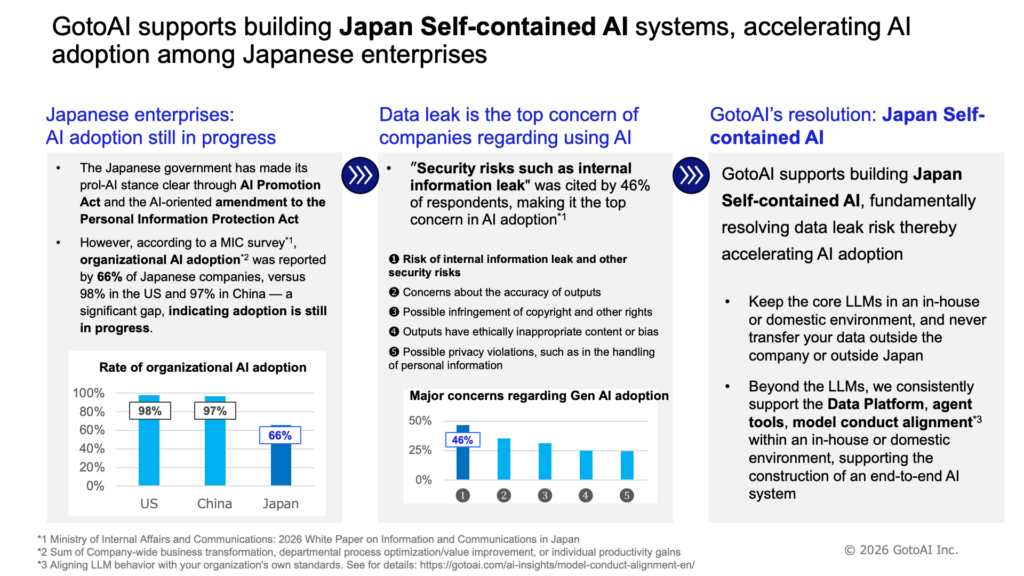
・AI adoption among Japanese companies is still only partway there
According to the Ministry of Internal Affairs and Communications’ White Paper on Information and Communications in Japan 2026, 66% of Japanese companies have made progress with organizational AI use (defined as any of company-wide business transformation, operational optimization and value enhancement, or individual productivity improvement). That remains far behind the United States at 98% and China at 97%.
・The single greatest concern is information leak
In the same survey, 46% of companies cited “security risks such as the leak of internal information”, which was the top ranked concern regarding using AI. Alongside it,
・uncertainty about the accuracy of outputs
・the possibility of infringing copyright and other rights
・ethically inappropriate content or the introduction of bias
・the possibility of privacy violations in handling personal data
were also raised as factors behind hesitation to adopt AI.
2. GotoAI’s resolution: Japan Self-contained AI
GotoAI supports the development of Japan Self-contained AI, accelerating AI adoption by resolving the risk of information leak from the root.
・Place the core LLMs inside your own organization or within Japan, so that your data is never transferred outside your company or outside the country
・We cover not only the LLMs but the data platform, agent tooling, and model alignment consistently in-house or within Japan, supporting the construction of an end-to-end AI systems
Architecture — Oumi Suite
Oumi Suite, the Japan Self-contained AI architecture proposed by GotoAI, is composed of four layers.
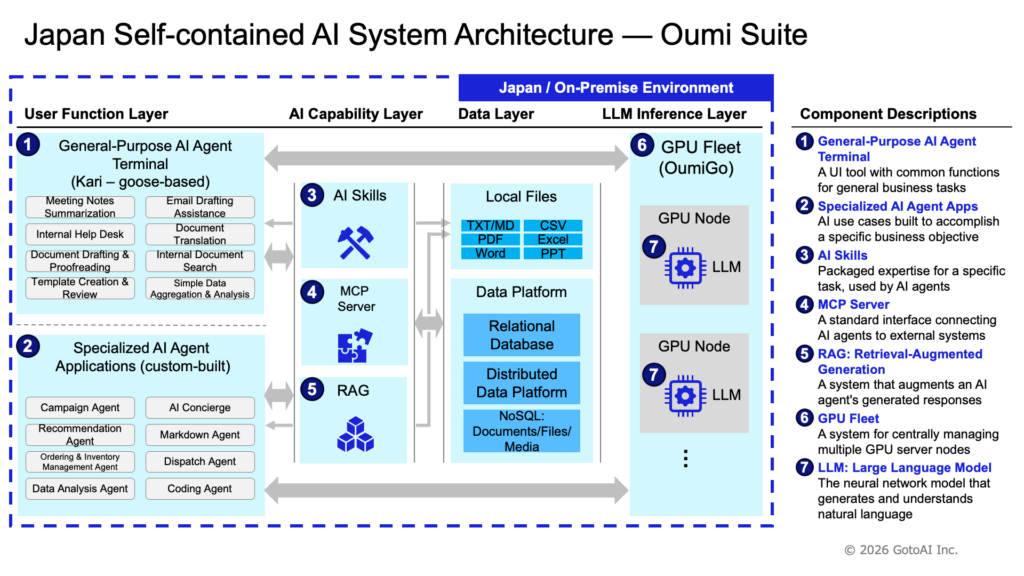
[ User Function Layer ]
❶ General-purpose AI agent terminal (Kari — goose-based)
Meeting-minutes summarization / email drafting assistance / internal help desk / internal document search / document drafting and proofreading / document translation / template creation and review, and more
❷ Specialized AI agent applications (individually built)
Campaign agent / data analysis agent / markdown agent / recommendation agent / AI concierge / vehicle dispatch agent / ordering and inventory management agent / coding agent, and more
[ AI Capability Layer ]
❸ AI Skills — packages of specialist knowledge for specific tasks, for use by AI agents
❹ MCP servers — a standardized interface connecting AI agents to external systems
❺ RAG (Retrieval-Augmented Generation) — the mechanism by which an AI agent extends its knowledge when generating an answer
[ Data Layer ]
・Local files (CSV / PDF / Excel / Word / PPT / TXT・MD, and others)
・Data platforms (relational databases / parallel distributed data platforms / NoSQL: documents, materials, media)
[ LLM Inference Layer ]
❻ Oumigo GPU fleet — centrally manages multiple GPU server nodes, running LLMs in-house or within Japan
❼ LLM: Large Language Model
3. How an engagement proceeds
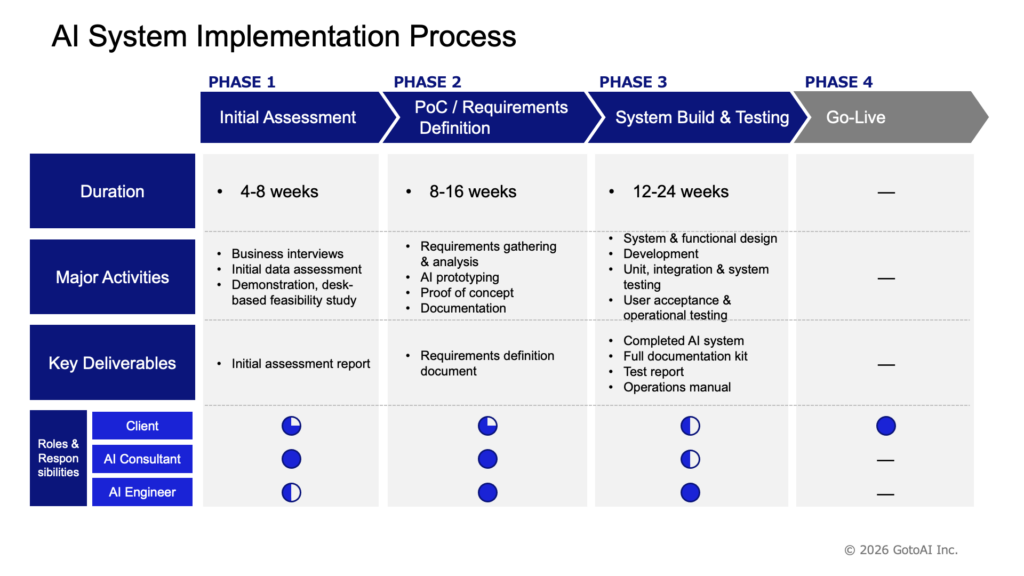
[PHASE 1] Initial assessment (duration: 4–8 weeks)
Major activities: business interviews / initial data assessment / desk-based study
Output: initial assessment report
[PHASE 2] PoC / requirements definition (duration: 8–16 weeks)
Major activities: requirements gathering and analysis / AI prototyping / proof-of-concept trials / requirements drafting
Output: requirements specification
[PHASE 3] System build and testing (duration: 12–24 weeks)
Major activities: system and functional design / program development / unit, integration and system testing / user and operational testing
Output: the complete AI system / full documentation set / test reports / operating procedures
[PHASE 4] Go-live
(Separate discussion needed) Through an optional hyper-care period, Client starts to take the responsibility of running and maintaining AI systems for the business operations