
AI requirements definition determines, on the basis of what validation has shown, a comprehensive target state for AI Agent, data, outcomes, organization and transition in 8–16 weeks. Using our own framework “ADOPT”, GotoAI converts the AI initiative you have selected into a robust, specific, feasible and measurable execution plan, and carries it through into the PoC and requirements definition that follow.
Why the ADOPT analysis matters
For an AI initiative that the initial assessment has prioritized, the key requirements are still vague. Proceeding straight to a PoC in that state carries a range of risks — the PoC misses the point, execution efficiency drops, and so on. At the same time, a lot of information remains unknown at this stage, so drawing up a perfect execution plan is almost impossible. This is the classic chicken-and-egg dilemma.
This is where GotoAI proposes the ADOPT (Agent, Data, Outcome, People, Transition) framework and supports you in drawing up the AI execution plan. From there we connect the PoC and impact validation, updating its content agilely and iteratively, to arrive at the best available answer within the time and resource constraints.
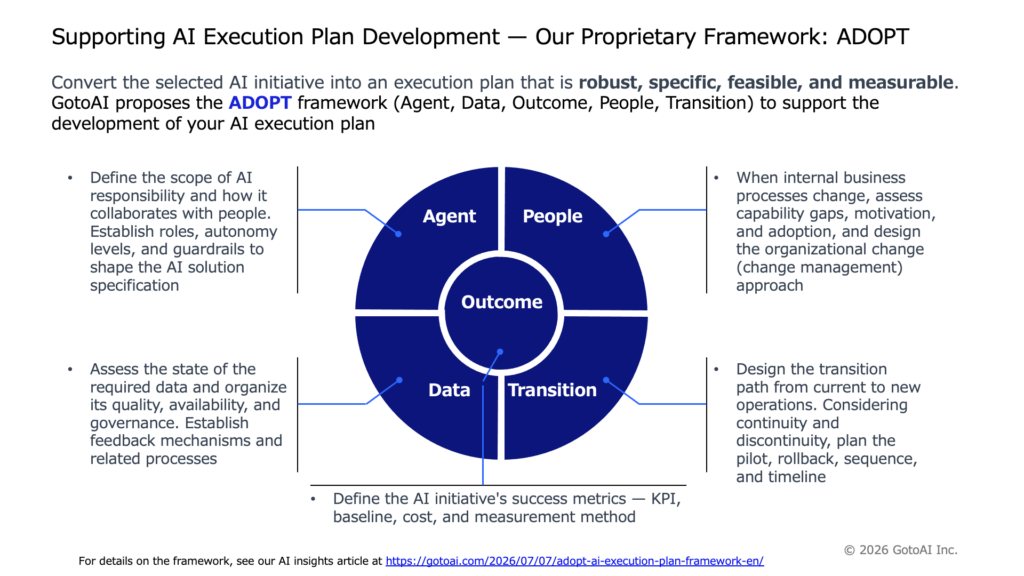
- Agent — Establish what the AI takes on and how it collaborates with people. Define its role, autonomy level and guardrails, and design the AI solution
- Data — Establish the state of the data you need, and organize data quality, availability and governance. Put mechanisms such as feedback loops in place
- Outcome — Define what counts as success for the AI initiative: KPIs, baselines, costs and measurement methods
- People — For the changes to internal business workflows, assess capability gaps, motivation and adoption, and design the organizational change (change management)
- Transition — Design the path from current operations to the new way of working. Account for continuity and discontinuity, and plan the pilot, rollback, sequence and timeline
Organizing these five perspectives comprehensively, on the basis of the initial assessment findings, keeps the PoC and requirements definition that follow from losing sight of what has to be validated and what has to be defined.
For the details of the framework, see our AI Insights article.
ADOPT: From Strategy to Implementation — A Framework for AI Execution Planning
From PoC to requirements definition, in four steps
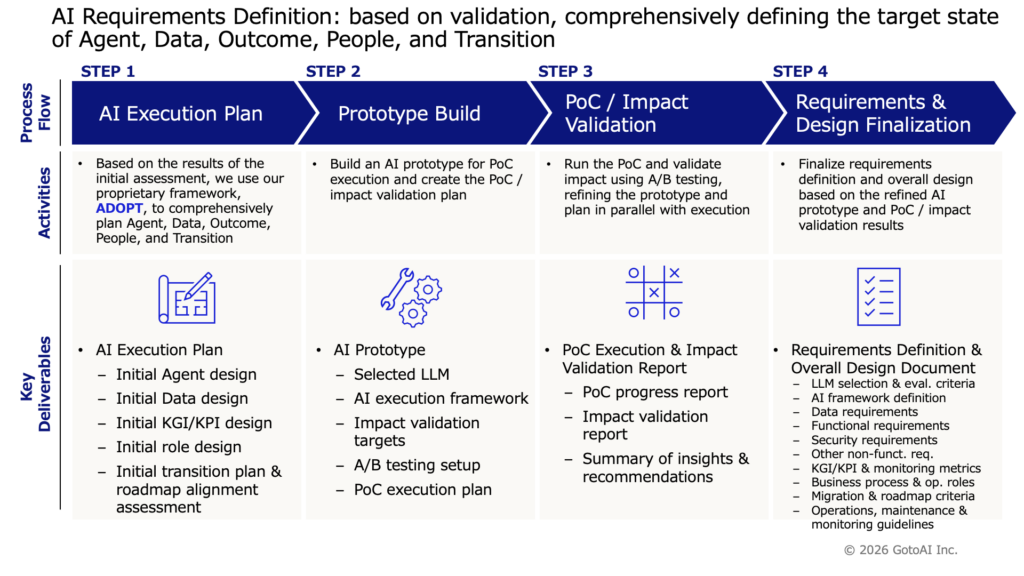
[STEP 1] Drawing up the AI execution plan
Building on the findings of the initial assessment, and using ADOPT, our own framework, we draw up a comprehensive plan covering AI, data, outcomes, the organization and the transition
▶ Output: AI execution plan
- Initial Agent design
- Initial data design
- Initial KGI/KPI framework design
- Initial role design
- Initial transition plan & roadmap alignment assessment
[STEP 2] Prototype build
Build the AI prototype for running the PoC, and draw up the plan for the PoC and impact validation
▶ Output: AI prototype
- Selected LLM
- AI execution framework
- Impact-validation measurement targets
- A/B testing mechanism
- PoC execution plan
[STEP 3] PoC and impact validation
Run the PoC and validate the impact of the initiative using A/B testing. Implementation proceeds in parallel with revisions to the prototype and the plan
▶ Output: PoC execution and impact validation report
- PoC progress report
- Impact validation report
- Summary of insights & recommendations
[STEP 4] Finalizing requirements and overall design
Based on the revised AI prototype and the results of the PoC and impact validation, we carry out and finalize the requirements definition and overall design
▶ Output: Requirements definition and overall design document
- LLM selection and evaluation criteria definition
- AI framework definition
- Data requirements definition
- Functional requirements definition
- Security requirements definition
- Other non-functional requirements definition
- KGI/KPI and monitoring metrics definition
- Business workflow and operating role definition
- Criteria for judging system migration and fit with the company-wide roadmap
- Operations, maintenance and monitoring guidelines