
What decides success or failure in an AI production build is how well people and the organization are aligned, how the development process is run, and how technology is chosen and turned into lasting assets. Across a 12–24 week AI production build project, GotoAI works alongside you as an advisor committed to maximizing the quality, efficiency, and impact of AI development (the implementation itself is carried out by you and your development partners).
Our approach
Leading an AI production build to success requires establishing the three pillars of People & Organization, Process, and Technology, and pursuing the Excellence that sits at their core.
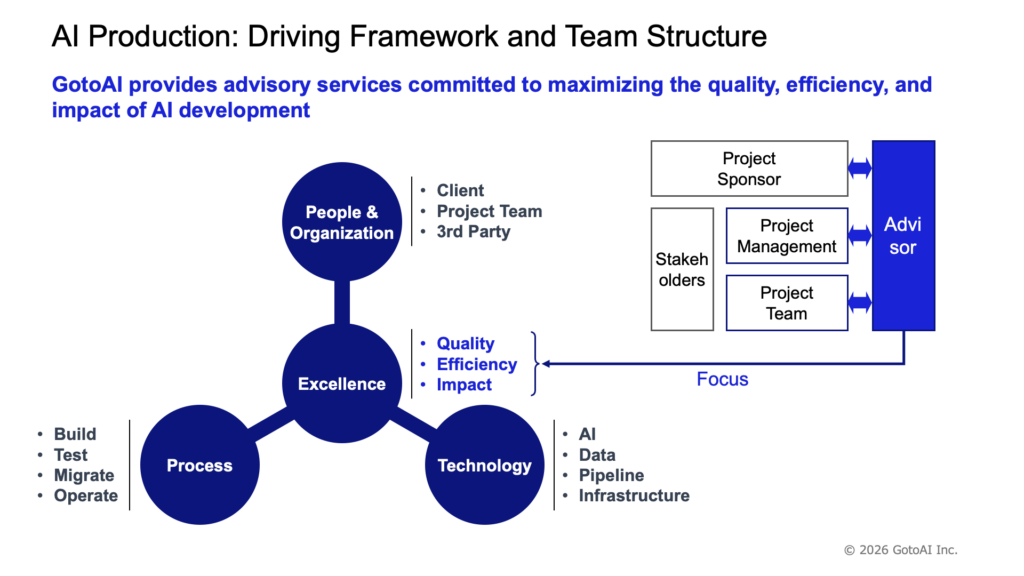
- People & Organization
Build a structure in which the client, the project team, and third parties drive the work as one. - Process
Move the project forward steadily through the build, test, migration, and operations phases. - Technology
Design and build AI, data, pipelines, and infrastructure as a coherent whole. - Excellence (the target outcome)
Pursue excellence in results along three axes: quality, efficiency, and impact.
[Project structure]
GotoAI works alongside the project sponsor, project management, the project team, and stakeholders as an advisor, focusing in particular on realizing Excellence — the quality, efficiency, and impact of AI development.
Key Success Factors for an AI project
Success factor 1: Align every AI decision
Precisely because AI development involves numerous decisions without precedent, careful alignment with clients and stakeholders is even more essential.
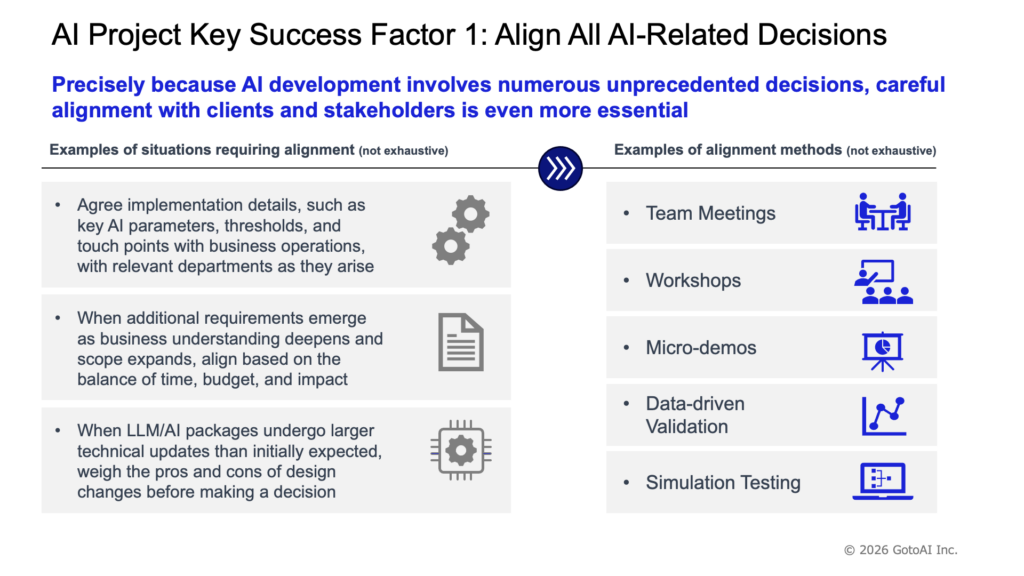
Examples of situations that call for alignment
- Agree implementation details, such as key AI parameters, thresholds, and touch points with business operations, with relevant departments as they arise
- When additional requirements emerge as business understanding deepens and scope expands, align based on the balance of time, budget, and impact
- When LLM/AI packages undergo larger technical updates than initially expected, weigh the pros and cons of design changes before making a decision
Examples of how alignment is reached
- Team meetings
- Workshops
- Micro-demos
- Data-driven validation
- Simulation testing
Success factor 2: Follow an agile development approach
AI development contains many novel elements, strongly requiring an output-driven, agile approach.
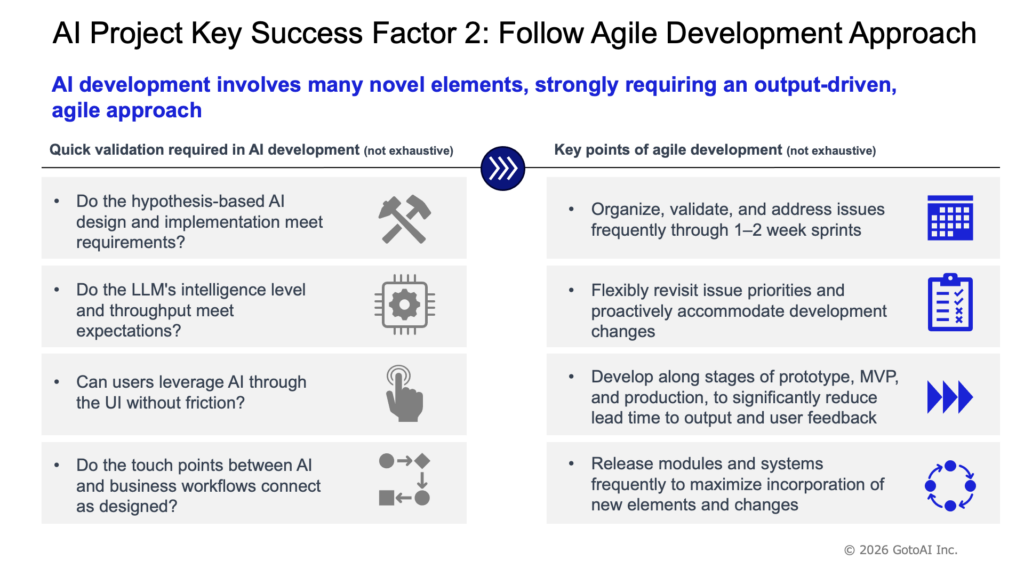
Questions you want to validate quickly in AI development
- Do the hypothesis-based AI design and implementation meet the requirements?
- Do the LLM’s intelligence level and throughput meet expectations?
- Can users leverage AI through the UI without friction?
- Do the touch points between AI and business workflows connect as designed?
Key points of agile development
- Organize, validate, and address issues frequently through 1–2 week sprints
- Flexibly revisit issue priorities and proactively accommodate development changes
- Develop along stages of prototype, MVP, and production, to significantly reduce lead time to output and user feedback
- Release modules and systems frequently to maximize incorporation of new elements and changes
Success factor 3: Maximize the asset value of AI and data
Select and adopt technology that can be leveraged across individual projects to maximize the value of AI and data as company-wide shared assets.
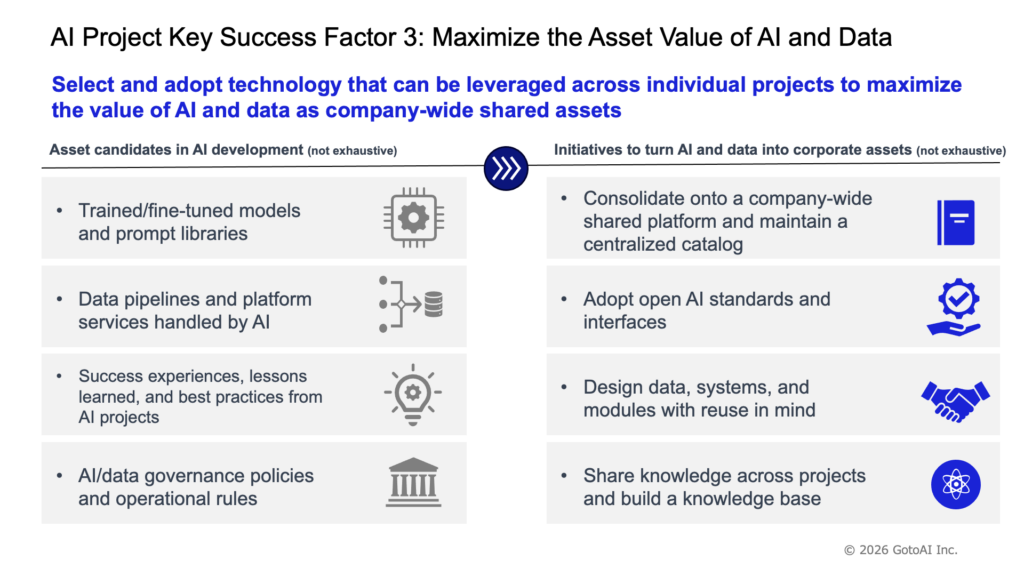
What to consider turning into assets in AI development
- Trained/fine-tuned models and prompt libraries
- Data pipelines and platform services handled by AI
- Success experiences, lessons learned, and best practices from AI projects
- AI/data governance policies and operational rules
Initiatives that turn AI and data into corporate assets
- Consolidate onto a company-wide shared platform and maintain a centralized catalog
- Adopt open standards and interfaces of AI technology
- Design data, systems, and modules with reuse in mind
- Share knowledge across projects and build a knowledge base