
To maximize the impact of AI adoption, you must evaluate AI initiatives properly. SCAN is an analysis framework focused on the capture of AI value and its linkage to corporate strategy.
When crafting an AI strategy, there are at least two difficulties. The first one is that the relationship between AI and human labor is highly dynamic: depending on how you frame and structure it, the direction of the initiatives can shift dramatically. The second one is that AI’s impact on companies, and on entire markets, is expected to be enormous, so the corporate strategy that has been built up so far will not necessarily align with the AI initiatives.
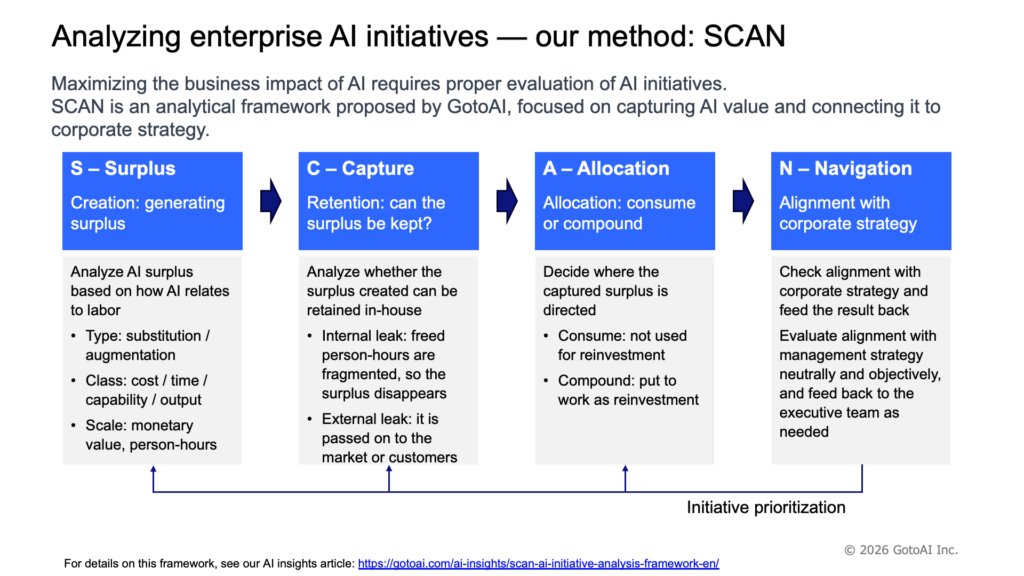
This article proposes an analysis framework for AI initiatives called “SCAN.” SCAN works through four interlocking lenses: (1) the Surplus that AI creates, (2) the Capture of that value, (3) the Allocation of the captured value, and (4) the Navigation that checks its course against corporate strategy. This lets you assess each initiative’s impact objectively, while also feeding any gap with the corporate strategy back to management, neutrally.
Overview of SCAN
- Surplus: Analyze the relationship between AI and labor to pin down, across substitution and augmentation, where the surplus arises, what type it is (cost / time / capability / production), and at what scale.
- Capture: Can the created surplus be kept? Assess the internal leak (it evaporates inside the company without becoming cash) and the external leak (it passes to the market / customers), and measure how much actually remains.
- Allocation: Where is the captured surplus directed? Judge whether the destination is one where the asset compounds into tomorrow’s advantage, or one where it is consumed in a single shot.
- Navigation: Confirm whether the course of the analysis is aligned with corporate strategy. Where it diverges, feed back to management — neutrally — whether to shelve the initiative or revisit the strategy.
SCAN runs from “appraisal” (S → C) through to “putting to use” (A → N). Note that the final N (Navigation) is not a judgment gate that rules a conclusion out. It asks whether the course aligns with strategy; where there is a gap, it returns that gap to management as “shelve the initiative, or revisit the strategy.” Competitive advantage — the robustness of the “moat” — was already judged in C, and the compounding of value in A; N is responsible only for assessing course-fit.
To make the discussion concrete, let’s take up a single hypothetical business example.
“Ichimaru Ramen” is a regional chain marking its 20th anniversary. It currently operates 80 stores across the region, beloved locally for its house-made noodles and broth and supported by many regulars. The president has set a strategic goal: “expand to 100 stores within three years and grow operating profit by 30%.” His message is clear — no race to the bottom on price; the company will keep being chosen for its distinctive taste and brand.
1. Surplus (Where AI Frees Up)
Does AI substitute for human labor, augment it, or both? Pure substitution reduces working time and cost, but does not increase output itself. Augmentation, on the other hand, raises employees’ capabilities and lifts per-person productivity to grow output — it works on the “expand the pie” side. In slightly technical economic terms, this new benefit that AI’s adoption creates is what we will call the “surplus.”
Once the type of surplus has been identified, the next step is to estimate its scale. This is case by case. Sometimes it is easy to quantify, sometimes not. What matters is to sort it into at least three levels — Low / Mid / High — so you can later compare initiatives against one another. If you measure each one against the same yardstick (company-wide revenue, say), the levels become comparable side by side.
Ichimaru Ramen uses a central-kitchen model: two factories centrally produce noodles, broth, and toppings and ship them to each store. Four area managers draft a weekly delivery plan the prior week, then confirm, adjust, and finalize the next day’s volumes the day before. Traditionally, however, plans relied on past results and intuition, so they deviated widely from actual results; even at an average of 10 hours per area manager per week, accuracy stayed low. As a result, waste cost reaches 5% of production cost — a high level.
Here we consider introducing an AI that automates demand forecasting and delivery planning. This can cut the area managers’ planning and revision time by 50%. Furthermore, on top of machine-learning demand forecasts, an AI agent that factors in real-time conditions such as weather and local events can be expected to bring waste cost down from 5% to 3%.
In short, this AI creates two surpluses — a “time surplus” for the area managers and a “cost surplus” from reduced waste — both of them are substitution-type, internal surpluses.
2. Capture (Keeping the Surplus: Leak Analysis)
How much of the surplus AI creates can you actually keep?
This is the “appropriability test.” Many analyses fixate on AI’s creation of value and miss this point — and that is exactly where they go astray. The heart of the question is not “who uses the AI” or “how much surplus AI can generate,” but “who reliably keeps the surplus that was created and turns it into value.”
Why doesn’t surplus automatically become value? Because there are two kinds of leak to get past.
Internal leak — Consider a case where AI cuts working time. Even if you free up, on average, 0.3 of a person’s time per employee, you cannot cut 0.3 of a person’s labor cost (a fixed cost). If each person frees a little time but total labor cost and output stay the same, the surplus AI created vanishes without ever turning into cash.
External leak — Consider a case where AI increases output. If the market is saturated or price elasticity is high, you cannot sell the extra volume at the same price and are forced to cut prices — so the surplus passes into the customer’s wallet.
And what forces that price cut is the competition. If the AI initiative does not create differentiation, or if adopting it actually dilutes your own strengths, rivals follow suit, you cannot hold your price, and your competitive advantage erodes over the long run. In other words, competitors act as the pressure that pushes the surplus outward through the market price.
How much of the surplus AI created you can keep — surviving both the internal and external leaks — is one of the single most important checkpoints in analyzing AI initiatives.
Let’s check the two surpluses the AI creates at Ichimaru Ramen. One is the cut in the area managers’ delivery-planning time; the other is the reduction in waste cost.
The waste-cost reduction hits the bottom line directly, because purchasing simply drops — it remains plainly as cash, an easy-to-capture surplus.
The area managers’ time, by contrast, tends to leak internally because of the “0.3-person” problem. But Ichimaru has high-value work to pour that time into: improving management tasks that overtime has crowded out — above all, planning new store openings. Redirect the freed time here, and the time surplus does not vanish; it turns into the value of “better store-opening decisions.” In other words, this time can be captured precisely because there is somewhere worthwhile to direct it.
3. Allocation (Directing the Surplus)
Where do you direct the surplus you managed to capture?
There is one key question here: whether to consume the captured surplus for “today,” or to invest it for “tomorrow” so it compounds. That said, the fine decisions — how much to put where, and in what order — belong to a later step. At this stage, you simply organize what surplus is available and how much, and whether each candidate destination falls on the “today” side (consumption) or the “tomorrow” side (compounding).
Ichimaru’s surplus has several possible destinations.
A short-term boost to existing stores: put the freed waste cost toward renovations or extra seating, and direct the area managers’ time to supporting busy or low-margin stores. It helps this period’s earnings, but left alone it tends to end as a one-off — so it leans toward consumption.
Preparing new store openings: fund property acquisition and store construction, and invest the area managers’ time in opening plans, negotiations, and staffing — thickening the store-network asset. This leans toward compounding.
Building out the data and AI foundation: fix the foundational gaps this project surfaced, and raise the very “capture power” of the next AI initiative. This is the clearest compounding of all — a flywheel that generates the next cycle’s surplus.
4. Navigation (Course-fit)
So far we have analyzed the surplus AI creates, its capture, and where it is allocated. Does the result align with the company’s strategic goals?
Broadly speaking, there are three patterns.
- Aligned: There is a clear roadmap from the AI initiative to the strategic goal, and the captured, allocated surplus contributes to it directly.
- Conditionally aligned: As-is, it diverges somewhat from the strategic goal, but with the right conditions attached it can be steered back toward it.
- Divergent (a gap): No clear path of contribution to the strategic goal can be found. Even so, you do not reject it on the spot. As discussed below, you return it to management as a trigger to revisit the strategy.
Note that, throughout the analysis up to here, the corporate strategic goal is treated as an almost purely external variable. That said, since corporate strategy works top-down on every business activity, an analysis conducted within that context may well already be influenced by it. There is one caveat, however: AI — generative AI in particular — is a very recent phenomenon, and conventional corporate strategies most likely have not yet factored AI in adequately.
Therefore, rather than forcing SCAN’s findings to fit the corporate strategy, it is important to assess any gap neutrally and objectively and — if a gap exists — to treat it as an opportunity to revisit the strategy, and feed it back to management.
Evaluated for course-fit, Ichimaru’s AI initiative is, in its main part, “aligned.” The cash flow improved by lower waste cost, and the area-manager time now freed for redeployment, both contribute strongly to realizing the store-expansion strategy.
There is, however, one gap: building out the data and AI foundation has barely been mentioned in the strategy discussion so far.
Yet if the company aims beyond 100 stores to further expansion, a scale-up underpinned by data and AI becomes strategically important. And it overlaps with the very core of the president’s strategy — “win the market on distinctive taste and brand, not on discounting” — because data and AI can raise the consistency of the taste and deepen customer understanding, keeping the brand the reason customers choose it.
This read is fed back to the president neutrally and objectively — not cut off with a snap judgment, but returned as a trigger to widen the strategy by one step.
In Closing — After Appraisal Comes Execution
SCAN is a framework that appraises AI initiatives by “the value you can capture” and “course-fit with strategy.” Through the four lenses — Surplus (S) → Capture (C) → Allocation (A) → Navigation (N) — it objectively assesses whether an initiative truly leaves value with your company, and whether that lines up with where the company is headed. Conversely, SCAN deliberately does not measure build cost, feasibility, or ROI: those belong to the world after the first-step decision of “do it, or don’t.”
That is why appraisal is only half the journey. To actually harvest the value you have found you can keep, you need the “body of execution”: choosing the AI agents that will carry it, putting the supporting data in order, measuring and iterating on outcomes, moving people and the organization, and transitioning fully from existing operations. In the next article, we will go through this second half of the journey as a framework in its own right.
To start, take your leading AI idea and run it through the four questions — What surplus appears? Does it really stay? Does it compound? Does it fit the direction? The value of AI is not what it creates, but only what you can keep. And that value remains within the company only once it has been fully executed.