
Massive AI Investment, Record High Corporate Earnings, and Strong Long-Term Earnings Expectations, These All Create a Self-Reinforcing Cycle — And It Delivers a Clear Message to Japan
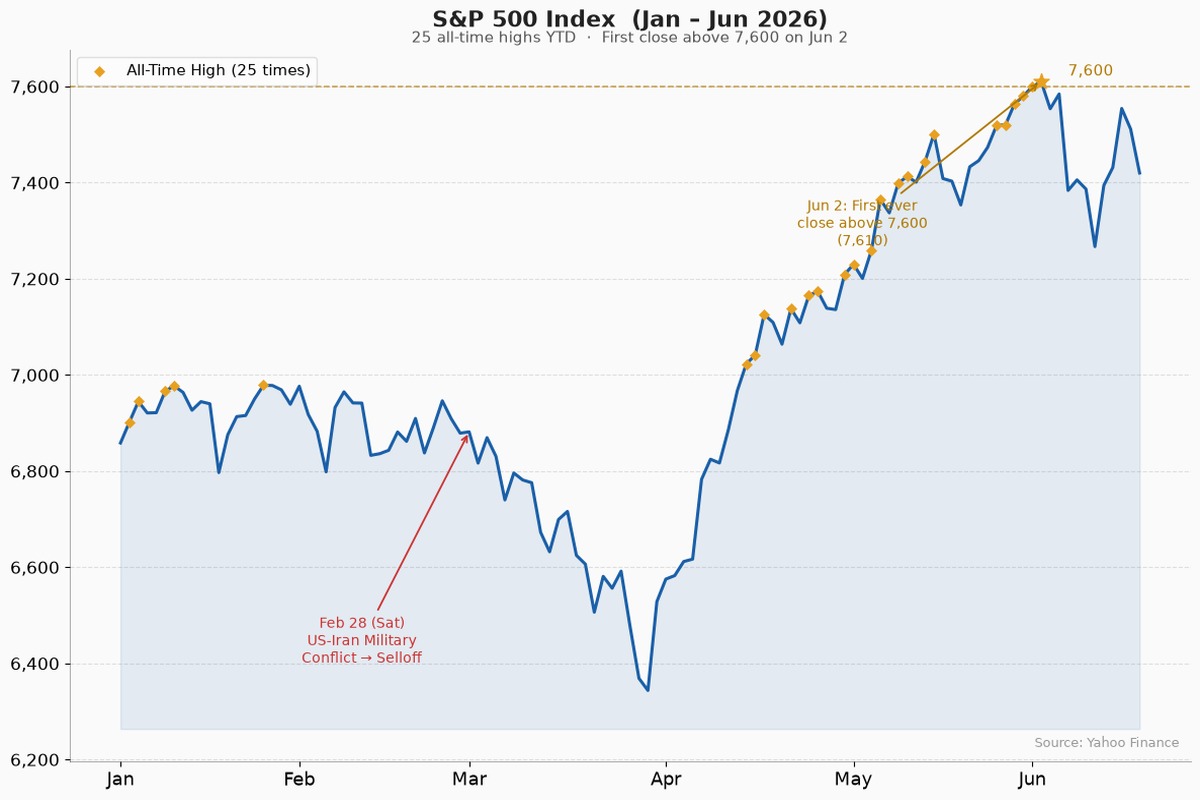
As of June 2026, the S&P 500 index has hit 25 all-time highs since the start of the year, surpassing 7,600 points for the first time in history on June 2nd. Despite the military clash between the United States and Iran that broke out on February 28th, and the resulting surge in crude oil and gasoline prices caused by the ongoing Strait of Hormuz blockade, the stock market is reflecting the vigorous growth momentum of the American economy. What lies behind this?
The AI Technology Revolution Creates a Massive Market Investment Opportunity
First, let me explain from the basic principles of economic growth. When viewing economic activity from the broad perspective of production, distribution, and consumption, expansion on the supply side — that is, improvement in productive capacity — is the starting point for economic growth. To that end, investment is indispensable to expand equipment, labor, and other resources. Simply put, sufficient investment is necessary for robust economic growth.
However, in capitalism-based free markets, investment activities are left to the judgment of countless individual investors, and as a result, within a system premised on dispersed decision-making, it is normally nearly impossible to concentrate massive investment into a single market or a single industry.
Here, the significance of AI development becomes apparent. Large language models (LLMs), developed by pioneering AI companies such as OpenAI and Anthropic, have demonstrated capabilities that match and even exceed human intelligence in certain areas. This has heightened expectations that the productivity of society as a whole will dramatically improve in the near future.
As a result, the hypothesis that “investing in AI development and applications will yield high returns in the future” has gone beyond the realm of a hypothesis and has transformed into market conviction. This conviction is generating a massive concentration of investment in the United States, the global center of AI development.
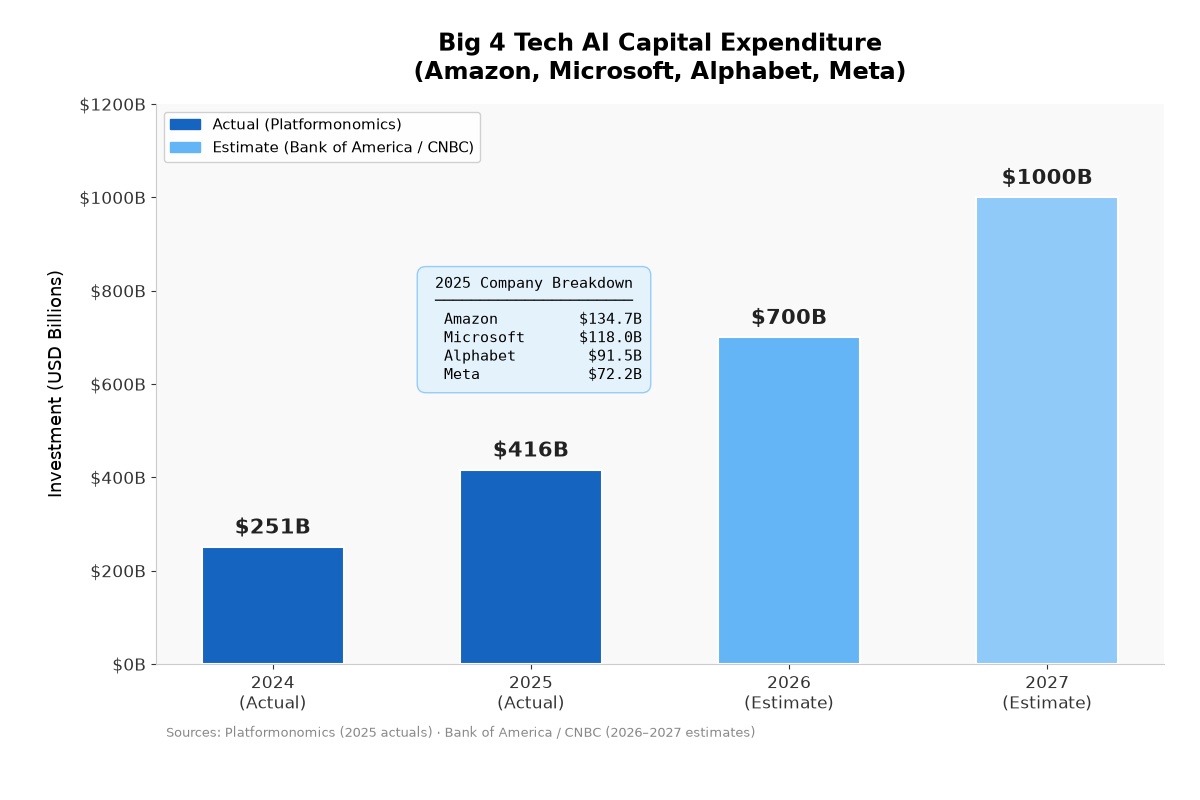
Looking at actual figures, in 2025 alone, the four companies of Amazon, Microsoft, Alphabet, and Meta reached approximately $416.2 billion in capital expenditure, recording a staggering increase of 66% year-over-year (per Platformonomics). Furthermore, according to a CNBC article, research and estimates by Bank of America and others project approximately $700 billion to be invested in AI equipment in 2026 and approximately $1 trillion in 2027. According to an Investing.com article, Barclays analysis shows that almost all of the growth in U.S. business fixed investment in the first half of 2025 can be explained by AI-related investment.
In this way, a “concentrated massive investment” that would normally be difficult to realize in conventional capitalism, has appeared in the United States under the common goal of AI. This investment is spreading across a wide range of industries including data centers, semiconductors, IT equipment, power infrastructure, and cloud services, powerfully driving growth across the entire US economy.
The US Corporate Profitability at Record Highs — What’s Behind It
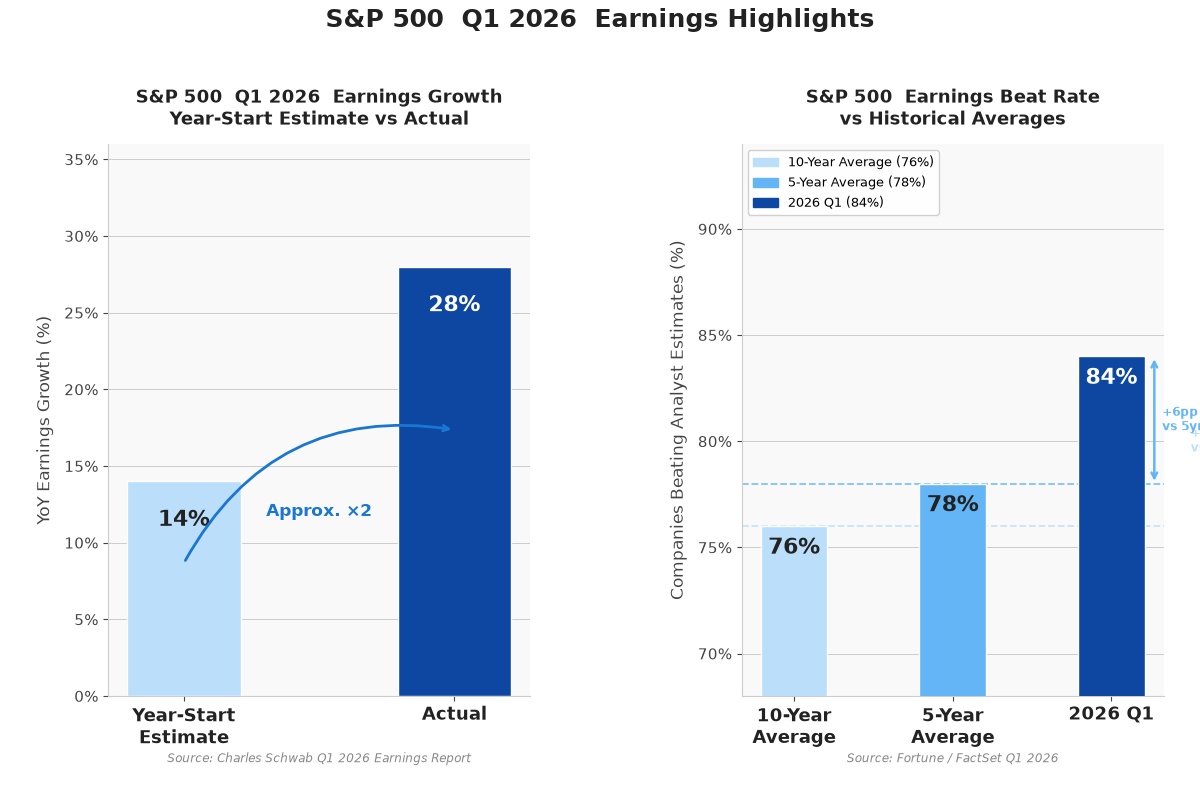
Accompanying this massive AI investment, corporate profitability in the United States has improved to record levels. According to Charles Schwab’s Q1 2026 earnings report, the profit growth rate for the S&P 500 in that quarter reached approximately 28% year-over-year, nearly double what the market had predicted at the start of the year. Furthermore, Fortune reported that the proportion of companies whose profits exceeded analyst estimates in that quarter reached 84%, significantly surpassing both the 5-year average (78%) and the 10-year average (76%).
However, it is important to accurately understand the true picture behind this profit growth. The S&P 500’s record growth rate reflects two fundamentally different channels of how the effects are playing out.
The first is the “demand spillover effect of AI investment.” Massive capital expenditure is flowing directly into semiconductors, data centers, cloud services, and power infrastructure, rapidly expanding the revenues and profits of those sectors. According to Goldman Sachs analysis, approximately half of the S&P 500 profit growth in 2026 is expected to be driven by such AI infrastructure-related companies. This is the story of those “selling” AI — a structural benefit that arises precisely because the United States is the world’s largest AI investment hub.
The second is the “productivity improvement effect through AI utilization.” This is the channel through which companies actually introduce AI into their operations and improve profitability through efficiency gains, cost reduction, and quality improvement. While still in its early stage, results are steadily accumulating. Goldman Sachs research reports that companies utilizing AI in software development and customer support have seen productivity improve by approximately 30%. EY’s research found that 96% of organizations that invested in AI experienced productivity improvements, with 57% reporting “significant improvement.” Canada’s CIBC disclosed that in Q1 2026 alone, AI utilization resulted in 1.2 million person-hours of efficiency gains and improved financial product conversion rates by 44%.
With these two channels compounding each other, the record profit performance is further solidifying an optimistic outlook for the future. According to FactSet analysis, analysts predict the S&P 500 profit growth rate for the full year 2026 to be 21–23%, with net profit margins also expected to reach 13.9% — the highest level since FactSet began measuring in 2008. Goldman Sachs has also raised its EPS forecast for the S&P 500 in 2026 to $340 (+24% year-over-year) and set a year-end stock price target of 8,000 points.
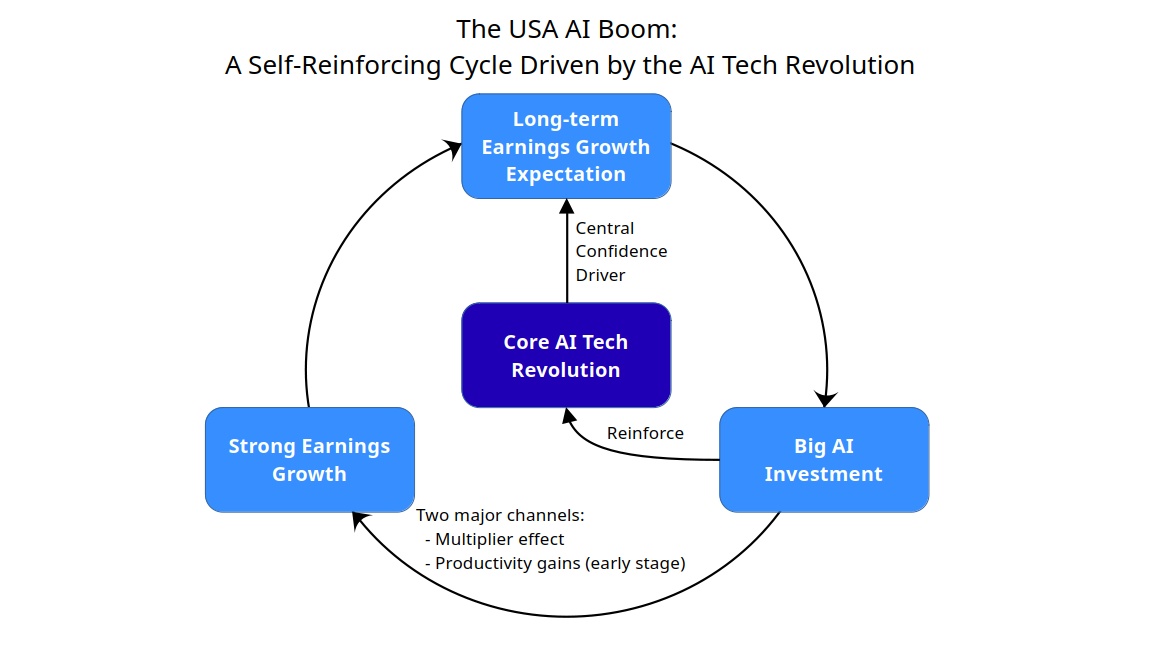
Here, a positive cycle emerges. Massive AI investment pushes up corporate earnings as a spillover effect, and as that performance repeatedly exceeds analyst predictions, the confidence of companies and investors in the future grows further. That confidence supports personal consumption through stock price rises and a wealth effect, and stimulates companies’ further desire to invest. In this way, the momentum of earnings growth, triggered by the AI technology revolution and the AI investment chain, is creating a structure where even the demand side supports the next phase of growth.
The Divergence in Capital Investment Structures Between Japan and America
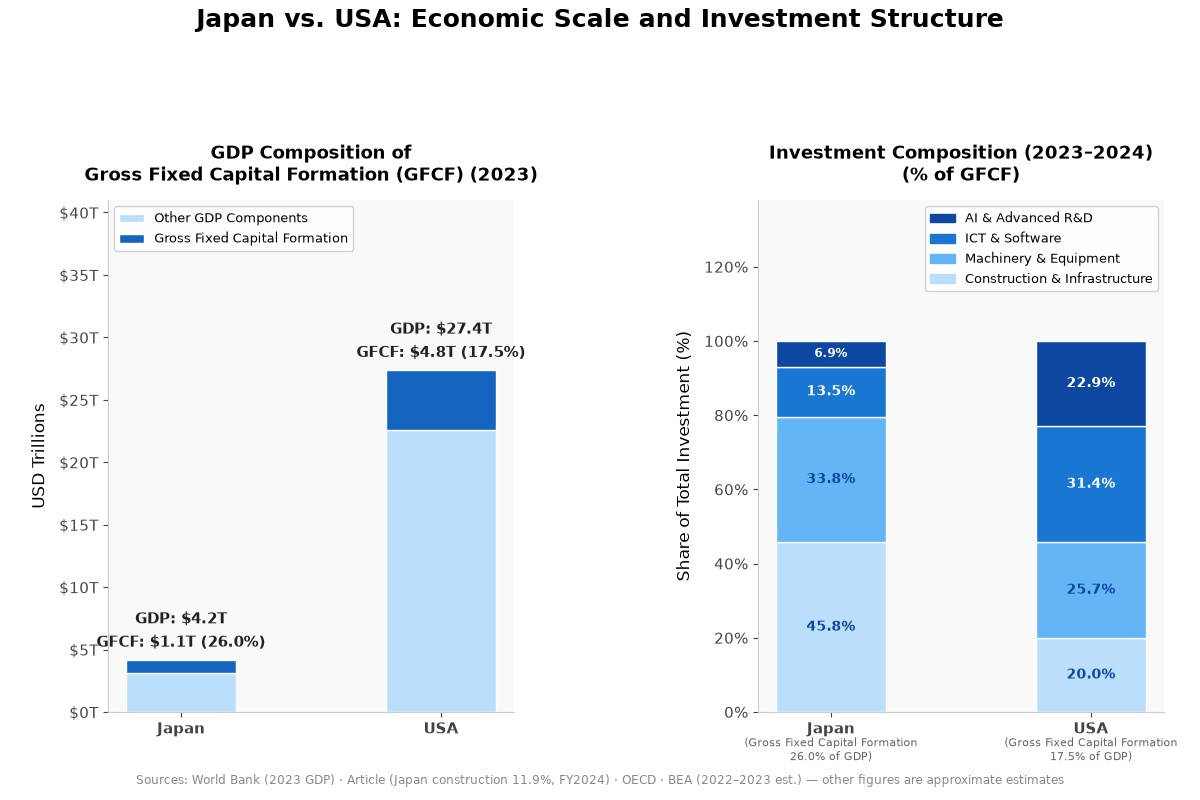
At first glance, Japan’s investment level is not low. According to World Bank data, Japan’s gross fixed capital formation reached 26–27% of GDP in 2023, far exceeding the approximately 17.5% figure for the United States. Contrary to the image of a country with low investment, Japan actually ranks among the developed nations with a high investment ratio.
However, the problem lies in the structure. The majority of Japan’s high investment ratio is accounted for by construction and infrastructure investment. According to Statista data, construction investment in fiscal 2024 remains high at 11.9% of GDP, with road infrastructure accounting for approximately 66% of the inland transport infrastructure investment. Meanwhile, per-capita machinery and equipment investment stands at $3,164, ranking 12th in the OECD — not a bad level in itself — but falls short of the United States’ $4,217 (5th place). In other words, Japan’s investment is concentrated in tangible physical capital such as roads, bridges, factories, and manufacturing equipment, with the allocation to next-generation growth engines such as AI and digital being overwhelmingly insufficient.
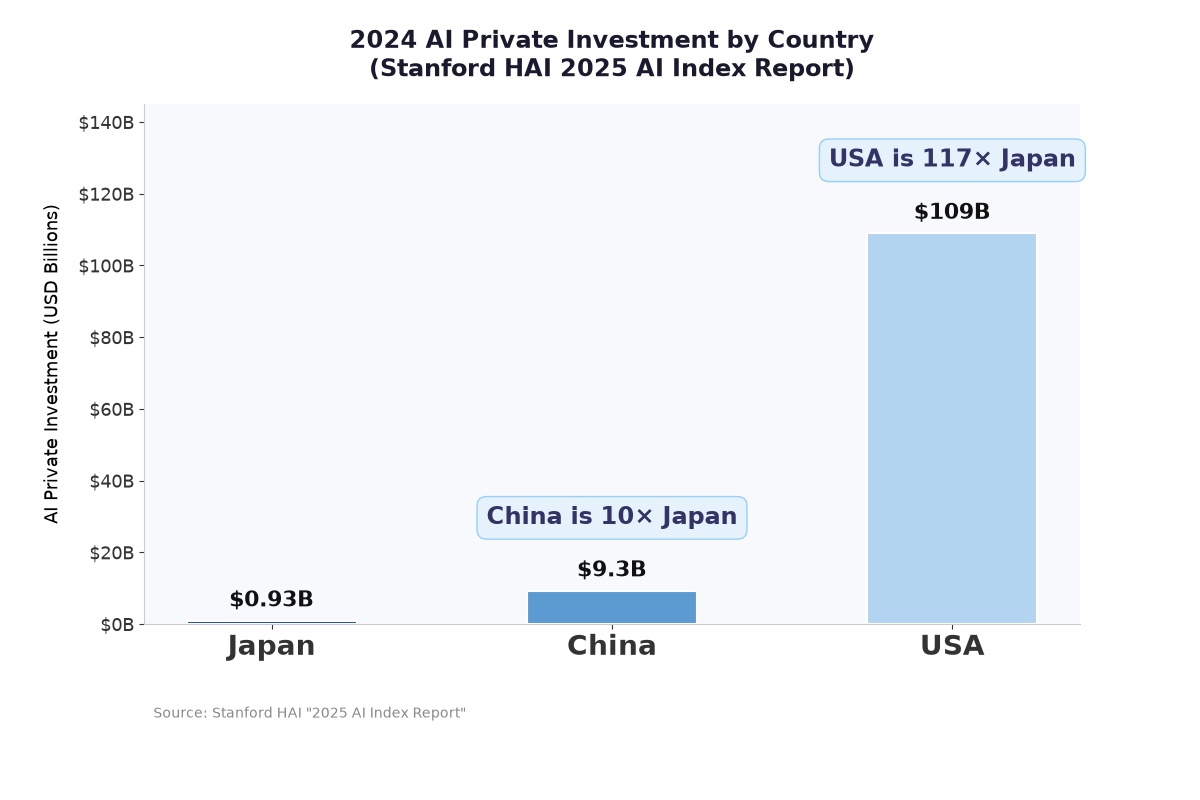
The gap is starkly apparent in AI investment figures. According to Stanford HAI’s “2025 AI Index Report,” private AI investment in 2024 was $109.1 billion for the United States and $9.3 billion for China, while Japan’s was a mere $930 million — 1/117th of the United States and 1/10th of China. In venture capital investment, which is essential for fostering startups, Japan’s market is approximately 1/64th the size of the United States, or 1/10th in GDP terms. Furthermore, according to Cabinet Secretariat “New Form of Capitalism” foundational materials, the growth in research and development investment from 2000 to 2022 reached 2.12 times for the United States compared to only 1.35 times for Japan — falling far behind in both absolute volume and relative momentum of growth investment.
The Top Priority Issue for Creating an Economic Boom in Japan in the Short to Medium Term
So, given this gap, what should Japan prioritize?
The answer is not simply to increase Japan’s AI investment. Japan’s foundational AI technologies, including LLMs, currently clearly lag behind the United States and China. While OpenAI and Anthropic’s models set the global standard, and China is rapidly catching up with DeepSeek and Alibaba’s Qwen, Japan-originated LLMs fall short in both scale and performance. It must be acknowledged that it is structurally difficult at this point to attract the kind of large-scale concentrated investment seen in the United States to areas where competitive advantage in investment returns cannot be demonstrated.
Here, let us recall the other channel of America’s record corporate earnings growth. It is not investment in foundational AI technology itself, but rather productivity improvement through AI utilization. Companies that utilize AI demonstrate high earnings growth as actual results, and these results generate optimistic outlooks for the future, which in turn attract further investment and economic activity — a positive cycle. There is room for the same logic to hold in Japan as well. If companies in Japan can demonstrate, as concrete results presented to the market, significant improvements in productivity and profitability through AI utilization, this would translate into market expectations of high future profitability, and could serve as the catalyst to trigger the same positive cycle.
Therefore, the essential issue that Japan’s economy should be addressing now is not “how to make large-scale investments happen in foundational AI technologies such as LLMs.” It is “how to effectively leverage AI to dramatically raise corporate productivity and profitability” — this is the top priority issue for Japan to achieve its own form of economic boom within one to several years.
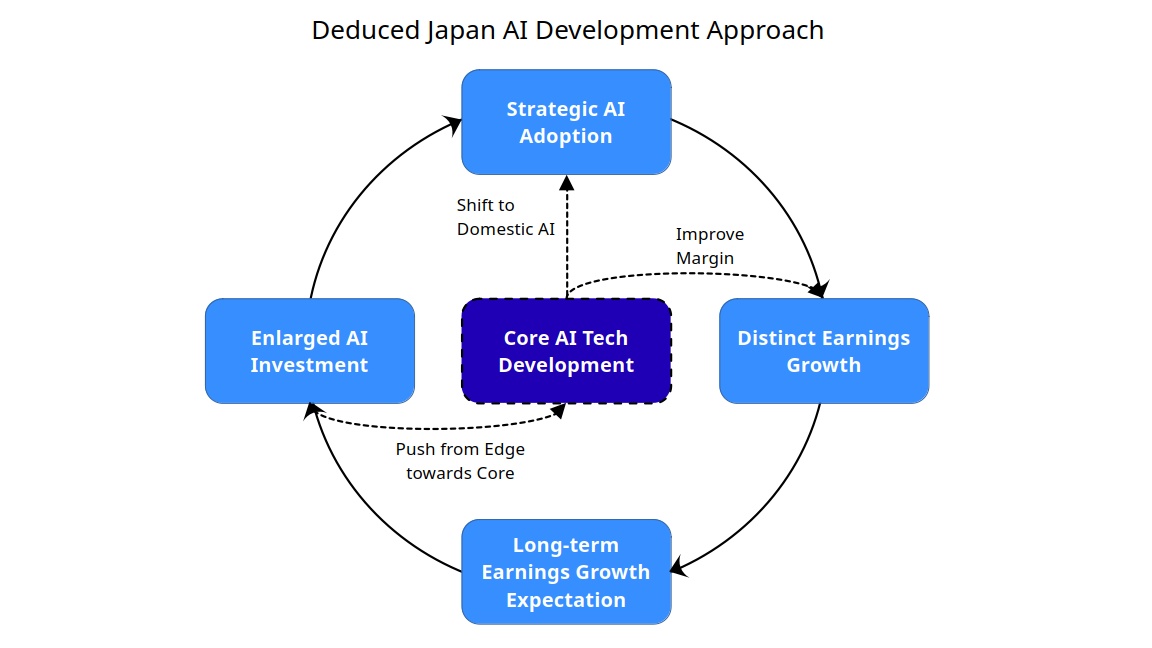
It has become unmistakably clear that cutting-edge AI technology is an indispensable element for maintaining national competitiveness. That is precisely why a clear development path is needed to achieve this AI capability. That path is already beginning to come into view: dramatically improving corporate profitability through AI utilization, thereby cyclically increasing investment, then re-balancing the center of gravity from AI utilization to core AI technology development, and further improving profit margins — this emerging approach to AI development may well represent the message that the current American AI boom is delivering to Japan.
References
- Yahoo Finance — S&P 500 Index Chart (Jan–Jun 2026)
- Platformonomics — “TGIF #115: February 6, 2026” — Big 4 Tech 2025 AI capex $416.2B, +66% YoY
- CNBC — “Tech AI spending approaches $700 billion in 2026, cash taking big hit” (Feb 6, 2026) — Bank of America et al. estimate ~$700B AI capex in 2026
- CNBC — “AI boom: Big Tech capital expenditures now seen topping $1 trillion in 2027” (Apr 30, 2026) — Outlook for AI capex exceeding $1T in 2027
- Investing.com — “Best Compute Stocks: Barclays Sees These Names as Key AI Infrastructure Plays” — Barclays: nearly all U.S. business fixed investment growth in H1 2025 attributable to AI
- Charles Schwab — “First Quarter 2026 Earnings: Feelin’ Alright” — S&P 500 Q1 2026 earnings growth ~28% YoY (~2x market expectations)
- Fortune — “84% of S&P 500 companies have beaten earnings estimates this quarter” (May 5, 2026) — Q1 2026 EPS beat rate 84% (vs. 5-yr avg 78%, 10-yr avg 76%)
- Goldman Sachs Insights — “The S&P 500 Is Forecast to Climb as Earnings Growth Powers Stocks Higher” — EPS forecast $340 (+24% YoY), year-end target 8,000; AI infrastructure drives ~half of 2026 S&P 500 earnings growth
- Yahoo Finance (Goldman Sachs research) — “Goldman finds ‘no meaningful relationship between AI and productivity at the economy-wide level,’ but a 30% boost for 2 specific use cases” — ~30% productivity improvement in software development and customer support
- EY — “AI-driven productivity is fueling reinvestment over workforce reductions” (Dec 2025) — 96% of AI-investing organizations report productivity gains; 57% report “significant improvement”
- Investing.com — “CIBC Q1 2026 slides: earnings surge 47%, AI drives efficiency gains” — CIBC: 1.2M person-hours saved and 44% financial product conversion improvement via AI in Q1 2026
- FactSet — “S&P 500 Earnings Season Update: May 8, 2026” — CY2026 S&P 500 full-year earnings growth forecast: 21.0%
- FactSet — “S&P 500 Reporting Highest Net Profit Margin in More Than 15 Years” — 2026 S&P 500 net profit margin forecast: 13.9% (highest since FactSet measurement began)
- World Bank Data — “Gross fixed capital formation (% of GDP) — Japan” — 2023: 26.01%
- World Bank Data — “Gross fixed capital formation (% of GDP) — United States”
- CEIC / OECD — “Japan: Total Inland Transport Infrastructure Investment: %: Road Infrastructure” — Road infrastructure accounts for ~66% of inland transport infrastructure investment
- OECD National Accounts Statistics — Per-capita machinery & equipment investment: Japan $3,164 (OECD 12th), USA $4,217 (OECD 5th)
- Stanford HAI — “The 2025 AI Index Report — Economy” — 2024 private AI investment: USA $109.1B, China $9.3B, Japan $0.93B
- Cabinet Secretariat, New Form of Capitalism Realization Council — “Foundational Materials” (31st Meeting, Feb 27, 2025) — R&D investment growth 2000–2022: USA 2.12x, Japan 1.35x